
The EU Just Ended Its €150 Duty-Free Threshold — Here's What Changes for Your Store
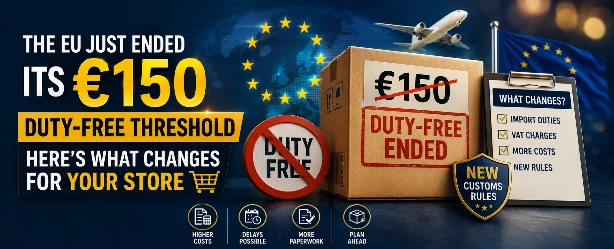
If you ship products to European customers, a real change landed on July 1, 2026, and it's worth understanding even if you're a small store. The EU has removed the €150 duty-free threshold that used to let low-value parcels cross the border without paying customs duty. Every commercial shipment into the EU is now duty-liable, regardless of how cheap the item is.
This isn't a minor technical footnote — it directly affects landed cost, checkout pricing, and how you handle product data if you sell to EU buyers from the US, Pakistan, or anywhere else outside the bloc.
What Actually Changed on July 1, 2026
Previously, any parcel valued at €150 or less could enter the EU without customs duty — import VAT still applied, but duty itself was waived under a mechanism called "de minimis." As of July 1, 2026, under Council Regulation (EU) 2026/382, that exemption is gone. Every low-value shipment now faces a flat €3 customs duty per product line item, whether it's sent through the IOSS scheme or not.
This is described as an interim measure — the flat €3 charge is meant to hold things over until mid-2028, when a fuller customs reform kicks in and low-value shipments start getting assessed at standard, product-specific tariff rates instead of a flat fee. So this change is really phase one of a longer transition, not a one-time adjustment.
Why the EU Is Doing This
The reasoning the EU has given publicly is about leveling the playing field — the old exemption made it cheaper for a non-EU seller to ship a single item directly to a customer than for an EU-based retailer to import the same product in bulk and pay standard duty on it. With low-value parcel volume from outside the EU growing dramatically in recent years (China-origin parcels specifically have been cited as a major share of this), the exemption increasingly looked like it was distorting competition rather than just simplifying customs for small shipments.
It's also part of a broader global pattern — the US removed its own $800 de minimis exemption in 2025, and the EU's move follows a similar direction: major economies pulling more low-value parcels into formal customs processes with more data requirements attached.
What This Actually Means for Your Store
The €3 fee itself is small, but it's not the whole story. On a $20 item, an extra $3 (roughly) in duty is a real percentage hit to margin, especially if you're already working with thin margins on lower-priced products. On a shipment with multiple line items, that €3 applies per item — a five-item order could mean €15 in duty rather than a flat per-shipment fee.
Every item now needs proper customs data. Under the new framework, shipments require accurate product descriptions, HS codes (the international commodity classification code), country of origin, and increasingly, standardized product identifiers like a GTIN, EAN, or UPC where one exists. If your product listings or fulfillment data have been loose about this (a generic description instead of an actual HS code, for instance), this is the moment that catches up with you.
IOSS registration still matters, just for a different reason now. The Import One-Stop Shop VAT scheme still governs how VAT gets collected on these shipments, but it's worth being clear: IOSS does not cover the new €3 duty. VAT and duty are now two separate obligations running in parallel, and if you're already registered for IOSS, you can't selectively opt out of it shipment by shipment.
Non-IOSS shipments face more friction. If a shipment isn't processed through IOSS, it has to clear customs individually in the destination member state rather than being cleared centrally — which affects both routing and delivery timing. If you're working with a third-party logistics provider or fulfillment partner for EU orders, it's worth directly confirming how they're handling this distinction operationally, rather than assuming it's automatically covered.
What's Coming After This
This July 2026 change is explicitly framed as temporary. The EU has also separately floated a proposed EU-wide handling fee (roughly €2-3 per package) targeted for around November 2026, though that piece has faced delays and isn't locked in the same way the duty change is.
The bigger shift lands around mid-2028, when the €150 threshold concept disappears entirely and low-value shipments get assessed using the same standard tariff rates that apply to any commercial import, based on the specific product and its country of origin. The flat €3 fee is a bridge to that point, not the final state of things.
What's Actually Worth Doing About This Now
Audit your product data for EU-bound items. If you sell to EU customers directly, make sure your product catalog has accurate HS codes and country-of-origin data attached — not just a general category, but something specific enough to survive an actual customs review.
Check with your fulfillment or shipping partner directly. Whether you use a 3PL, a specific carrier, or direct postal shipping, ask explicitly how they're handling the new duty collection and item-level declarations — don't assume it's automatically built into whatever service you were already using before July.
Reconsider pricing for EU-bound orders, if margins are thin. For a lower-priced product with several units per typical order, the per-item duty can add up in a way that's worth reflecting in EU-specific pricing or shipping charges, rather than absorbing it silently and watching margin erode.
If EU sales are a meaningful, growing part of your business, EU-based fulfillment is worth evaluating. Stores that hold inventory inside the EU and clear customs once on a bulk inbound shipment are largely insulated from this specific change, since the duty structure targets individual low-value parcels crossing the border directly, not bulk imports cleared as a single shipment.
Common Questions
Does this apply to me if I'm a small store shipping just a few orders a month to the EU? Yes — the removal of the threshold applies regardless of your total volume or the size of any individual shipment. There's no small-seller exemption built into this change.
Is this the same as the EU VAT rules that came in a few years ago? No, though they're related. The 2021 reform applied import VAT to all low-value goods regardless of price. This 2026 change is specifically about customs duty, which had remained exempt for low-value shipments until now — VAT and duty are separate obligations that both now apply.
Does using IOSS mean I don't have to worry about the new duty? No — IOSS covers VAT collection specifically. The new €3 duty is collected through a separate mechanism and applies whether or not a shipment goes through IOSS.
Will this fee stay at exactly €3 per item long-term? No — it's explicitly described as an interim, flat-rate measure meant to bridge the gap until a fuller reform (expected around mid-2028) replaces it with standard, product-specific tariff assessments.
Does the UK have the same rule? No — the UK operates its own separate customs regime and has not mirrored this specific EU change. If you sell to both UK and EU customers, it's worth tracking each market's rules independently rather than assuming they move together.